Saturday, June 16, 2012

Hayagriva Maddi.


Hayagriva Maddi is Sweet dish prepared in Madhva and TMG households. There is a story behind this delicious dish.
Sri Vadhiraja was a very great Saint. Sri Vadhiraja Swami used to hold a bowl containing A mixture of boiled chana dal [bengal gram], on his head, meditating on Hayagriva. Lord Hayagriva used to come in the form of a White Horse and eat the contents, placing its forelegs on the shoulders of Swami Vadhiraja.It used to leave a little as prasadha for Swami Vadhiraja.
Recipe For HAYAGRIVA MADDI.
2 Cups ---- Chana Dal, 2 Cups ---- Jaggery, 1/4 Cup ---- Ghee, 1/2 cup grated or cut into small bits of Dry coconut, 8/10 raisins.8/10 ---cachew nuts -- cut into peices, 1/2 spoon -- cardamom and a dash of Nutmeg.Gus-gusa/poppy seeds---one table spoon.
METHOD :--- Preasure cook the Chana Dal in 4 cups of water, drain the water, [ this water can be used to make saar].
Heat the cooked dal and jaggery till it is semi dry, stirring continuesly.Add the jaggery and let boil and reduced to almost solid consistancy. Remove from fire In the ghee fry the kaju, raisins and  gus-gusa[poppy seeds] and the coconut and add to the cooked mixture.
  The Sweet is ready to serve.


Monday, January 9, 2012

Keshava Naama.

These stanzas were sung by a Krishna Baktha called Kanaka daasa. He it is lived for 98 years and when sang the last stanza of this he breathed his last.It is full of meaning and both men and women can sing it.
1] EEsha ninna , paada bhajane, aase indha maaduvenu dosha rasi nasa madu Srisha Keshava.
2] Shranu Hokeniaya enna, marana samayadhalli nina, chrana smarane karunasaya Narayana.
3] Shodhisu yena bavadha kalasa, bhodhisaya Gnana venage, Bhadhisuva Yamana bhadhe bidiso Madhava.
4] Hinda neke yonigalalli, bandhu bandhu nondhenaiya, Indu bhavadha banda bidiso thandhe Govindha.
5] Brishta nenesa beda Krishna, ishtu mathra bedigombe, shrishta rodene ittu kashtav bidiso Vishnuve.
6] Madhana naya ninna mahime, vadhana dalli nudi yuvanthe, hridhayadhalli hudhikasaya Madhusudhana.
7]Kavidhu khondu iruva papa, savidhu hoguvanthe madi, javana bhadheyanu bidiso Thrivikrama.
8]Kaama janaka ninna naama, premadindha paduvantha, nemavenage paalisaya swami vamana.
9] Modhalu ninna paadha puje, odhuguvanthe maado yenna, hrudayadolage sadhana maadu mudhadhi Sridhara.
10]Husiyanaadi hote horeve, vishyadhalli rasika-nendu, husige haakadhiro yenna Hrishikeshane.
11]Kaama krodha bidisi nana,naama jiveyolage nudiso.sri mahanubhavanaadha Damodhara.
12] Bidu bavaneke januma, badha nagi kalushdindha, gedhu popa budhi thoro Padmanabhane.
13] Panka-jaksha ninu yena, manku bhudhi yanu bidisi, kinkaranna madikollo Sankarshana.
14] Yesu janma bandharenu, dasa nalla venu nanu, ghasi madadhiru yena vasudevane.
15] Bhudhi shunya-nagiyena,badha kayakuhaka manava, thidhihrudaya shudha mado Pradhumnane.
16] Janani janaka neneyendu,nenevenaya dhinabandhu, yenage mukthi paalisenduAnirudhane.
17] Harushadindha nina naama, smarisuvanthe maadu kshema, irisu charana-dhali prema Purushothama.
18] Saadhu sanga kotu ninu, paadha bhajane ithu enna, bedha-maadadhiru yena Adhokshaja.
19] Charu-charana thori yenage,parugaanisaya konege, bhara haakiruva ninage Narasimhane.
20] Sanchithartha papagalu, kinchithadha pidegalu,munchithavagi kalayabeku swami Achutha.
21] Gnyana bakuthi kotunina, dhyanadhali netu sadha,hina bhudhi bidiso munna Sri janardhana.
22] Japa thapa anushta-navilla, kupitha-gamiyadhayena, kripeya madi kshamisabeku Upendrane.
23] Moreya viduvenaya ninage, sharadhi shayanashubamathiya, iriso baktha rolu parama purushaSrihare.
24] Putisale bedainnu, putisidhake palisena, ishtu mathra bedikombe Srikrishnane.
26] Satya-vadha namagalu, nithya dhalli patisuvarige, arti-indha salhu-thiruva kartha KLeshava.
27] Marayadhale hariya naama, bharedhu odhi peldhavarige, karedhu mukthi-koduva Neleyadhi keshava.

These stanzas can be read every day by both men and women.
Kanaka was a great baktha of Krishna. When he was not allowed into the udupi Krishna temple he sang a song in kanada Bagilanu therudhu dhrushanava needu hariye. [meaning open the door and give your dharshan] at this the wall facing Kanaka broke open, so Kanaka could view hos Lord.
So pure was his Bhakthi.

Tuesday, December 27, 2011

Mandi Sambhar Bhath / Bisi Bele Huli Anna.

Mandi Sambhar Bhath or Bisi Bele Huli Anna. Mandi Sambhar bhath was originally made in a mandi.
A Mandi is a stone pot that was used for cooking.

For this relishing dish, the ingredients are:-

Rice---- two cups
Tur Dal ---- One cup
Tamarind --- about a small lemon size.
Dhania seeds-- two table spoons
red dry chillies --8/10 [as per taste]
chana dal --two tea spoons
pepper --one tea spoon
dal chini [lavanga patta]---one inch piece
cloves [lavanga]-- 4/5
vela [cadamom]--- 3/4
gus gusa [poppy seeds] --two table spoons
dry coconut ---1/2 cup
Curry leaves two sprigs
oil ...2 big ladles
hing ...per taste
haldhi powder 1/2 teaspoon

Boil rice and tur dal together
Soak the tamarind.
Fry all the dry ingredients one by one except dhania and chilli which can be fried together. till a good aroma emits.
Grind the fried ingredients finely using water.
Extract tamrind pulp.
In a thick bottomed kadai add two big ladles of oil and add a teaspoon of mustard
When it crackles, add the tamarind pulp, haldhi powder and hing and salt let it boil till the raw smell of tamarind disappears.
Now add the ground paste and let it boil for a few minutes then add the dal and rice and mix well.
If necessary add more water .
Cook this mixture, stirring all the time, till it reaches a good consistency.
Mix well serve with pappad or chips and raitha. if desired vegetables like capsicum, potato,beans,peas,can be added,along with dal and rice.

Tuesday, August 30, 2011

Worship of Ganesha in other countries.

TIBET. Tibetans Also worship Ganesha and they call him tsog gi dag po,mar chen, meaning the Great Red lord of hosts or ganas. They regard him as the destroyer of obstacles as we widely believe in India. They prefer Ganesha idols in red colour. Some idols show Ganesha in a dancing pose.
JAPAN. In Japan Ganesha is considered a minor diety, in buddhist pantheon.It is believed Ganesha was known in Japan in 806CE.They think invoking the blessings of Ganesha will lead to enlightenment and wordly gains. They offer him bliss buns made of yoghurt, honey, and pachrd flour. Other offerings include radish and wine. after the prayer they all partake these as prasad, like the Indians.
THAILAND. Here Ganesha is called Phara Phikanet or Phra Phikanesuan. Like in India here he is worshipped for fortune andsuccess, and the remover of obstacles. He is associated with the arts, education and trade.There are shrines for Ganesha accross Thailand and the most revered on is in the Royal Bramin Temple in central Bankok.
WEST JAVA.Here Gnesha is considered as the god of wisdom.Ganesha does not enjoy exclusive statusin indonashia, where the Ramayana and Mahabharath are popular and even Muslims take the name of the characters in the two great epics.Ganesha here is found in Siva temples.
AFGHANISTHAN. Excavations reveal Ganesha was worshipped here also. Before the arrival of Islam, Afghanisthan had close cultural ties with india, and both Hindu and Buddhist dieties were worshipped. Only some idols believed to have sculptedfrom the 5th to the 7th centuries have survived.
CHINA. Research indicate that the chiese also worshipped Ganesha.It is believed Ganesha reached Chine throygh Central China. Two representations found, indicate, that the Ganesha idols/statues reaches China very early. One is a fresco in rock cut caves at Tunhuang and other is a stone image carved in low relief in the rock cut temple at Kung-hsien.
May be this also proves Hindus had traveled far and wide centuries ago.

Thursday, July 7, 2011

Some Chatur Maas Dhanas.

<
In Chatur Maas, a number of Dhanas are gifted and some people observe , vrathas.
I will write a few easy once which any one can observe.
As I have already written, In all the four months some foods are not eaten. This is difficult, so some people, the elders in particular observe this on Dasami amd dwadasi days.
One Vratha is to serve whatever we want to eat at the start itself.No second helpings. One can serve them selfs as much as one would want, but strictly no helpings.
Another is not eating , vegetables like drumticks, brinjol,muli cabbage cauliflower, tomato, potato and such vegetables, which are considered , NOT FIT FOR SOWLA/MADI.
Some follow, one day eating, one day fasting, this rather difficult in todays world
PUJAS
1. On Thaptha mudra Ekadasi day colour two geja vastras, While doing puja and tulasi puja Adorn one to Krishna Idol and one to Tulasi. The next day, the one on the tulasi is removed and the one adorning Krishna is put for Tulasi vrindavan. and a new geja vastra for Krishna. This is repeated every day for four months. After four months on TulasiVivaha Day a bramin and his spouse are presented with Yatha Shakthi Vastra, with
2.On every Dwadasi day, during the four months any one of the following can be given to Bramin/Savashni. In all eight sets have to be bought, as they will be eight dwadasis in four months. The danas are to be given with pan, supari, dakshina, tulasi dala.If giving to savashni, it is to given with haldhi/kumkum and flower.
1] A pair of lamps, [2] Two vatis[katoris] with ghee and honey, [3]Two katoris with Haldi/kumkum,[4] All puja items like haldhi/kumkum,vathis soaked in ghee, geja vastra,flowers, sandal paste, mantra akshithaand a friut for naividya. On the last day ie on Uthana Dwadasi day, along with the puja materials with a pithal plate and two lamps, are to be given.
[5] A tulasi plant in a small pot or it is available is plastic covers is given and on Uthana Dwadasi day, a Pithal vrindavan with a tulasi plant is given.
[6] Every day from Ashada ekadasi day keep water in two small thambyas/thambige and perform puja reciting the prayer,GANGECHA YAMUNECHA< GODAVARI< SARASWATHI>NARMADHE SINDU KAVERICHA JALPITHENA SANNIDHIM KURU.and on the last dwadasi day gift two small thambyas.
These are very easy and any lady can observe.
If one can offord it Dhampathi Dhana, can also be given. 33 Dhampathis ie 33 couples can be gives saree/blouse and Dhothie/Shelya.

Saturday, June 11, 2011

chathur maas-------Vratha food.

Chathur maas starts from Ashada Shukla Paksha Ekadasi, this is also called theThapta Mudra Dharana Ekadasi as many Madhavas choose to have a Mudra dharane , from their religious heads.
The first Vratha is called, Shaka Vrath.During this period of one month none of the vegetables are eaten.Chana Dal and Basen is not allowed. None of the dry friuts. Only sugar candy. Turmiric, hing,mustard, methi, tamarind,chilli, corriander,curry leaves are not allowed.
The cereals allowed are Rice, Tur Dal, Mung daal and mung,Udad Dal,Wheat products ie [ wheat flour, sooji,maida] are allowed.Til Seeds, Ghee,Sugar,Jaggery,Milk, Butter are things allowed to eat.
As Sugar and Ghee are allowed sweets can be made, Sooji Halwa, Wheat Halwa,Padar Pheni/chiroti, and the likes.
To go with Rice saar/rasam can be made using tur dal water and jeera and pepper.
Tur dal is soaked and ground coursly [ like for ambody], add salt and make into balls and steam them.when it has boiled and cooled, crumble it , add pepper powder and season with jeera.
In a little oil fry table spoon of whole wheat, til jeera and pepper. add this to butter milk and bring to boil. This is Kadi.
soak and boil mung and make Usli.
One can, ofcourse ,use their imagination do some variation.

The Second Vratha Is Dhadhi Vratha, in which curds dont come into use. This is fairly easy as only dahi is avoided, but butter milk is allowed.

The third is Milk called Kseera Vratha, when Milk is not to used. But for cooking coconut milk can be used.

The fourth and the Last Vratha isDwidala Vratha. Dwidala is any plant which sprout double leaf is called Dwidala, and this is not eaten. The veg etables that can be eaten are, Banana both raw and friut,Banana Stem,Arvi, ginger, Maat[ mola keerai] coconut,curry leaves, mango raw/dried, jeera and pepper.
Raw Banana is cut into small bits steamed. To this is added wheat and pepper fried in a little oil and powdered.Season with jera and curry leaves. Banana can be be cut into slices to make chips.Banana Stem is cut fine with the strings removed ,dahi is added and salt to make Raitha.
maat is cleaned and boiled or make seasoning and add the maat, let boil, in the mean while fry wheatand til seeds, jeera and pepper, and grind fine adding coconut scrapping and the the boiled maat, add butter milk to make Kadi. Boil and peel the Arvi, cut into slices and fry till golden add salt. if desired add pepper powder.
Boil water add raw mango or dry mango peices and let boil add salt jeera and pepper powder to make sar.
To make Vadas. Boil 11/2 cup water add a little oil and a pinch of salt, add one cup rice flour.When this is cool add salt and til, shape inti vadas and deep fry.
IN ALL THESE VRATHA PREPERATINS BE VERY CAREFULL IN USING SALT , AS THERE NOT MUCH THICKAT AND AMBAT, THE DISHES WILL BECOME TOO SALTY.
One can add jaggery to the saar and a little to the kadi too.

Monday, March 7, 2011

Rangoli


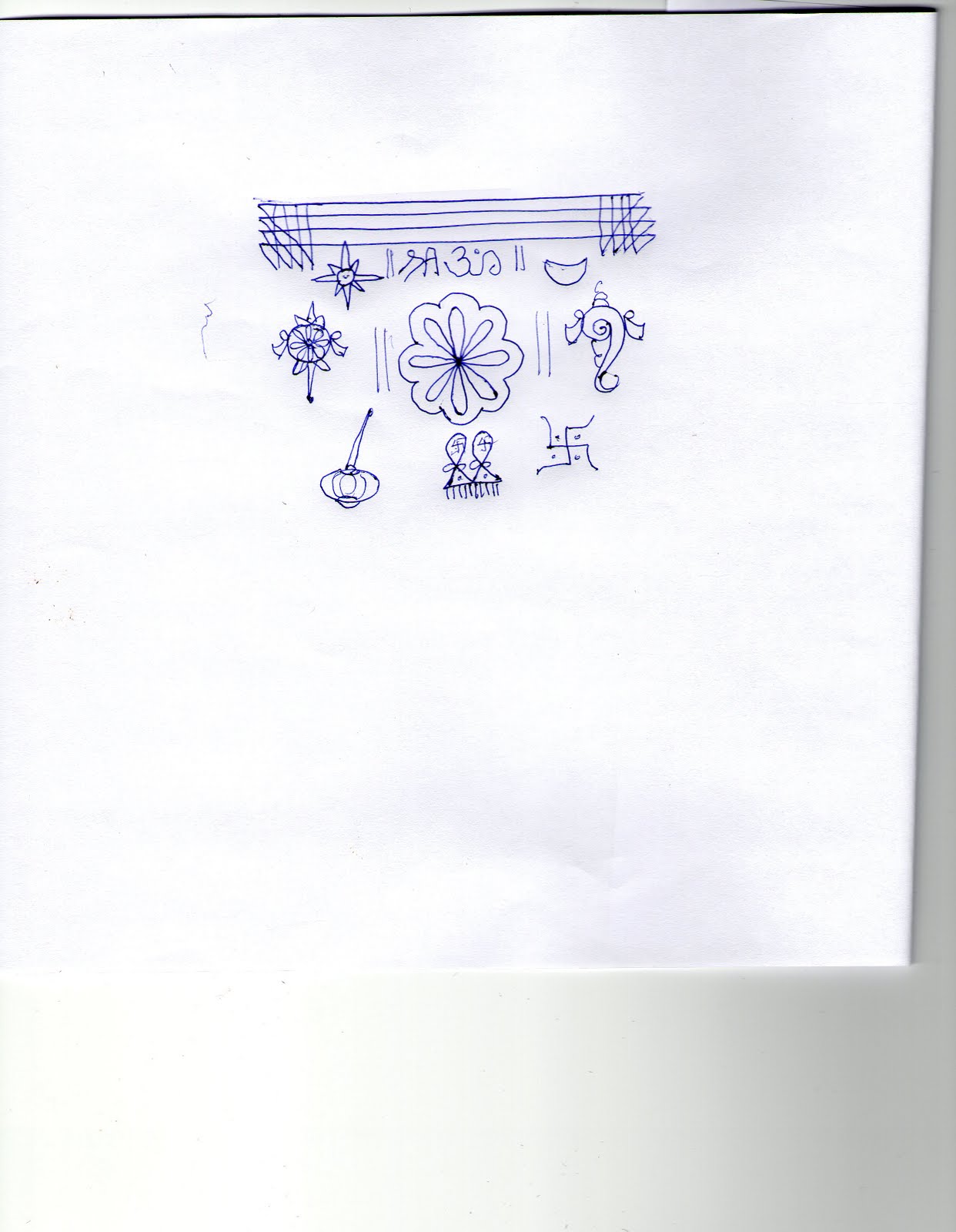
This is the Rangoli to be drawn in front of the Mandasana, everyday.